Opinion & Commentary
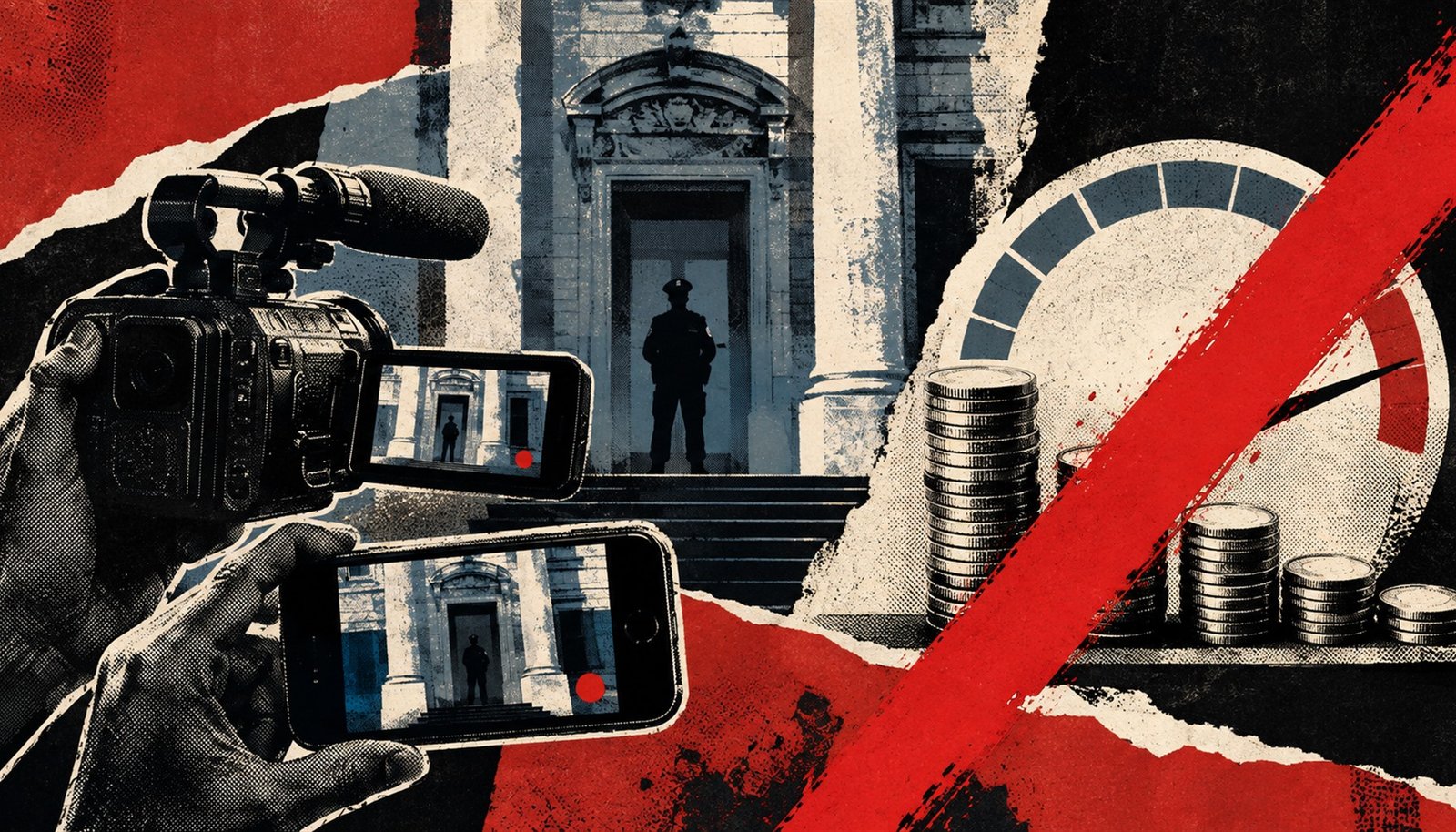
YouTube did not erase the cameras. It did something quieter and, for working creators, potentially just as effective: it took away the money that keeps those cameras moving.
In the final days of August, a cluster of First Amendment auditors and police-accountability channels reported that they had been removed from the YouTube Partner Program. Their videos and channels largely remained online, but advertising revenue, YouTube Premium revenue, memberships and other platform monetization tools disappeared. The affected creators said the notices arrived with little more than a reference to YouTube’s broad “creator responsibility” policy.
That distinction matters. This was demonetization, not a blanket ban. It is also why the episode is easy to minimize. Nobody was hauled out of a newsroom. No government censor stamped a publication “forbidden.” A private company simply changed the terms under which speech could earn money.
But “simply” is doing dishonest work in that sentence. For independent journalists and citizen watchdogs, revenue pays for travel, cameras, public-records fees, editing, legal defense and the time required to stand in a courthouse lobby until somebody finally answers a question. A platform can leave speech technically available while making its continued production economically impossible.
The constitutional case against YouTube is difficult. The public-interest case against unexplained, category-wide economic punishment is much stronger.
What happened to the auditor channels
Reporting and interviews assembled by The Real News Network identified a number of channels that said they lost YouTube Partner Program access at roughly the same time, including ANCAP Copwatch, James Freeman, John Felix, NC Tyrant Hunter, Long Island Audit, Rights Crispy and Press NH Now. The available reporting does not establish a complete count, and social-media estimates have run far ahead of what can be independently verified.
Long Island Audit creator SeanPaul Reyes, whose channel has more than a million subscribers, showed viewers a notice saying his channel was no longer earning after a review using automated systems and human reviewers. The reason displayed was a violation of YouTube’s creator-responsibility policy. Reyes said his dashboard showed no active Community Guidelines strikes or copyright strikes and that the notice did not identify a video, incident or statement that triggered the decision. Those are Reyes’ claims, not findings from an independent audit of his account.
The fact that several creators in the same loose genre reported near-simultaneous action reasonably suggests a coordinated policy sweep, a shared detection signal or a batch review. It does not, by itself, establish why the sweep happened or who—if anyone—asked YouTube to conduct it.
There is also evidence that the process is not immovable. The Real News Network interview reported that one affected creator, Phillip Turner, successfully appealed and regained monetization. That reported reversal makes the lack of individualized explanations even harder to defend. If one channel could be restored, what fact distinguished it from the channels that stayed out?
YouTube’s explanation is a label, not an answer
YouTube’s monetization rules say Partner Program creators must avoid egregious behavior that has a large negative effect on the community and must be respectful toward viewers, other creators and advertisers, both on and off the platform. YouTube reserves the power to suspend monetization across associated accounts. It says channel reviews may consider a channel’s theme, most-viewed and newest videos, watch time, metadata and About page.
That gives YouTube enormous discretion and almost no publicly measurable boundary. “Creator responsibility” could cover threats, doxxing, stalking or a deliberate harassment campaign. Few reasonable people would object to a platform acting against that conduct. But the phrase can also be stretched to cover confrontational reporting that embarrasses public employees, annoys police unions or makes advertisers nervous. Those are not the same thing.
YouTube’s separate harassment and cyberbullying policy is more concrete. It prohibits threats, doxxing, brigading, stalking and persistent targeted abuse, while recognizing that documentary, educational and public-interest context can matter. If a particular auditor crossed one of those lines, YouTube should identify the conduct. A creator cannot meaningfully appeal a conclusion when the platform refuses to disclose the premise.
The company says enforcement decisions combine automated systems with human review and that affected users are told their options. Its appeal rules generally allow 21 days after a suspension, with the possibility of reapplying after 90 days. A deadline is not due process in any meaningful sense if the accused still has to guess what evidence to rebut.
Why YouTube may have acted
There are at least three plausible explanations, and the public evidence is not strong enough to crown any one of them.
1. Advertiser risk and the economics of confrontation
Auditor videos often contain arguments, profanity, arrests, accusations of corruption and tense encounters with police or public workers. Even when the creator is legally right and the footage is newsworthy, advertisers may see an unpredictable environment. YouTube’s monetization program is designed around advertiser confidence, not around a neutral assessment of civic value.
That business logic can produce a rotten result. The most important accountability footage is often the footage least likely to look comfortable beside a household brand. If “brand safety” becomes the hidden editorial standard, polished official press conferences receive funding while adversarial scrutiny is treated as contamination.
2. A genre-level enforcement sweep
The timing across similar channels suggests YouTube may have reviewed the auditor category as a category. That could have been prompted by internal risk analysis, coordinated complaints, an automated classifier or a policy interpretation newly applied at scale. YouTube has not published a specific explanation for this wave that Killjoy Media could locate.
Category-level review is dangerous because “First Amendment auditor” describes a broad and unruly field. Some creators conduct careful public-records work and expose misconduct. Some bait low-level employees for a reaction. Some do both in the same week. Treating all of them as interchangeable substitutes judgment with stereotype.
3. Pressure from law-enforcement interests
Reyes has publicly raised a more serious theory: that police-union opposition to auditors, and possibly political relationships surrounding those organizations, helped produce the action. His response video points to public criticism from police-union leadership and describes his own recent investigations and legal conflicts. Earlier reporting by The Real News Network documented his confrontation with the Suffolk County Police Benevolent Association and the arrest that followed.
That context justifies questions. It does not prove a connection to YouTube. Public hostility from a private police union is not evidence that the union communicated with the company, and association with government officials is not evidence that those officials issued a threat or request. Reyes himself presented the claim as a theory requiring records and investigation.
The right response is not to mock the suspicion or promote it as fact. It is to obtain the records: complaint histories, appeal records, internal enforcement guidance and any communications among YouTube, police organizations and government offices. Until a documentary bridge exists, the pressure theory remains unproven.
Why auditors deserve a fairer hearing
First Amendment auditing can be abrasive. That is not a disqualification. The point of recording government in public is not to make government comfortable.
Auditors have documented unlawful orders, retaliatory arrests, invented policies, public-records obstruction and officers who change their behavior the moment a camera appears. They also force basic constitutional questions out of law-school casebooks and into post offices, police lobbies and town halls. The work overlaps directly with the subjects covered in Killjoy Media’s Police & Accountability and Rights & Privacy reporting.
Yes, the field contains provocateurs. So does cable news. So does political commentary. So does professional journalism. A fair system judges conduct, not the social class or institutional pedigree of the person holding the camera.
Traditional newsrooms have lawyers, insurance, payroll and relationships that help them survive conflict with officials. Independent auditors often have none of those protections. Platform revenue became their improvised funding model. Removing it without a specific explanation does not merely punish a personality; it can reduce the amount of raw, adversarial documentation available to the public.
The underlying recording can be protected speech
The law does not recognize an unlimited right to film anywhere, in any manner. Trespass rules still apply. Government may impose properly tailored restrictions in nonpublic forums and secure areas. A person cannot physically interfere with an officer and convert the interference into protected conduct by turning on a camera. Threats, doxxing and true harassment do not become immune because the speaker calls himself a journalist.
But recording and distributing information about police activity can sit at the core of the First Amendment. That is especially clear in the Fourth Circuit, which includes North Carolina. In Sharpe v. Winterville Police Department, the federal appeals court held that livestreaming one’s own traffic stop is protected speech and that a town policy forbidding it had to survive First Amendment scrutiny. The court still granted the individual officer qualified immunity because the right was not clearly established at the time of the stop, but the underlying speech principle survived.
That distinction is crucial: an auditor may possess a constitutional right against government interference with recording or livestreaming, yet have no constitutional right to receive advertising revenue from a private platform.
Why a direct First Amendment case against YouTube is unlikely to work
The First Amendment restrains government. It generally does not require a private company to host, recommend or pay for speech.
In Manhattan Community Access Corp. v. Halleck, the Supreme Court held that merely operating a forum for speech does not ordinarily transform a private entity into the government. The state-action rule is a formidable barrier even when the private forum is important to public debate.
The Ninth Circuit applied that logic directly to YouTube in Prager University v. Google. PragerU alleged that YouTube restricted access to some videos and demonetized others because of viewpoint. The court rejected the First Amendment claim because YouTube was a private entity, not a state actor. Calling YouTube a public forum did not change the result.
There is another obstacle. In Moody v. NetChoice, the Supreme Court emphasized that platforms’ choices about selecting, ordering and moderating third-party content can themselves be protected editorial judgment. Demonetization is not identical to deleting a post or arranging a feed, but the decision reinforces the constitutional protection platforms invoke against laws compelling them to carry or treat speech neutrally.
Put bluntly: YouTube can have First Amendment rights in the same dispute where an auditor cannot assert First Amendment rights against YouTube. That feels backwards when one side controls access to a global audience, but it is the current legal framework.
The exception that could change the case: government coercion
A private platform does not become a state actor merely because officials complain about content, criticize a creator or ask a company to enforce its rules. Government officials are allowed to speak and persuade.
They are not allowed to use public power to make a private intermediary punish disfavored speech on their behalf.
In National Rifle Association v. Vullo, the Supreme Court held that a plaintiff stated a First Amendment claim by alleging that a financial regulator pressured supervised companies to cut ties with the NRA. The constitutional line turns on context: authority over the intermediary, the content and tone of communications, threatened adverse action and whether the private company’s response appears voluntary.
That doctrine is why any claim of government involvement here must be investigated seriously—and why it cannot be assumed. If a police official merely denounced auditors, that is not enough. If a private union organized complaints, that is ordinarily private advocacy. If, however, a government official used regulatory authority, threatened YouTube or offered official favors in exchange for economic punishment of a disfavored class of speakers, the analysis would change dramatically.
The evidence needed would include emails, meeting notes, complaint referrals, regulatory communications and testimony connecting a state actor’s leverage to YouTube’s decision. Without that evidence, “censorship” is a political description, not yet a viable constitutional claim.
Contract and consumer claims face their own uphill climb
Creators may look to contract law, unfair-business-practice statutes or claims based on YouTube’s public promises of consistent enforcement. Those routes are not impossible in every factual setting, but broad platform terms and reserved enforcement discretion make them difficult.
A California appellate court considering PragerU’s state-law claims concluded that YouTube’s agreements did not promise viewpoint-neutral publishing decisions and did not support the claimed contractual restrictions on the platform’s discretion. A creator with a materially different notice, a specific promise or evidence of a knowingly false explanation could present a different case. Still, the practical lesson is grim: participation in the Partner Program is generally treated as conditional, not as a permanent entitlement to revenue.
That legal weakness makes transparency more important, not less. When private process is the only realistic process, a platform should provide the channel, video, timestamp or off-platform conduct at issue; the precise rule applied; whether automated detection played a role; and a genuine human appeal to someone empowered to reverse the decision.
YouTube’s current system asks creators to defend an entire body of work against an opaque label on a short clock. That is not constitutional due process—because YouTube is not the government—but it is still poor governance by a company that has made itself essential to modern public discourse.
Demonetization changes what the public gets to see
“They can still upload” is technically true and practically shallow. Producing accountability journalism costs money. A channel that loses ad revenue may reduce travel, abandon expensive public-records fights, stop hiring editors or place its best work behind a subscriber wall. The public then gets fewer encounters, less follow-up and less searchable evidence.
Alternative platforms and direct subscriptions can soften the blow. They do not replace YouTube’s audience, search visibility, recommendation system or archive. Fragmentation also makes footage harder for local residents, lawyers and reporters to find when an incident becomes important months later.
A system that economically rewards official narratives and lifestyle content while treating adversarial documentation as inherently unsafe will not eliminate conflict. It will merely make conflict less visible.
What accountability should look like now
The affected creators should preserve every notice, dashboard screen, appeal and communication. They should compare the exact language and timestamps of their enforcement actions, pursue public-records requests where government contact is suspected and avoid overstating what those records have not yet shown. A careful evidentiary record will do more than a hundred speculative thumbnails.
YouTube should disclose whether this was a coordinated review, identify the specific conduct attributed to each channel and explain why any successful appeal produced a different outcome. If the company believes auditors engaged in threats, doxxing or organized harassment, it should say so with examples. If the real concern is advertiser discomfort with confrontational police footage, it should admit that too.
Lawmakers should resist the temptation to dictate which speakers a platform must subsidize. That cure would create its own First Amendment problems. They can, however, require meaningful notice, consistent appeal procedures and transparency reporting for large platforms that make economic enforcement decisions at scale.
And the public should reject the lazy claim that every abrasive auditor is a menace—or that every person with a camera is automatically a hero. The defensible position is more demanding: protect the right to document government, judge misconduct with evidence, and require powerful intermediaries to explain punishments that can quietly determine which watchdogs survive.
YouTube may have the legal power to pull these creators’ paychecks. It has not yet earned public trust in how it used that power.
This article provides general legal analysis and is not legal advice.